


Most insurance agents don’t hate CRMs because they’re bad at sales.
They hate them because CRMs quietly expose a painful truth:
nothing actually changed after they bought one.
Same leads.
Same follow-up issues.
Same stress.
Same inconsistent results.
So the conclusion feels obvious — “This CRM just isn’t good.”
But here’s the uncomfortable reality:
Most CRMs don’t fail because of missing features.
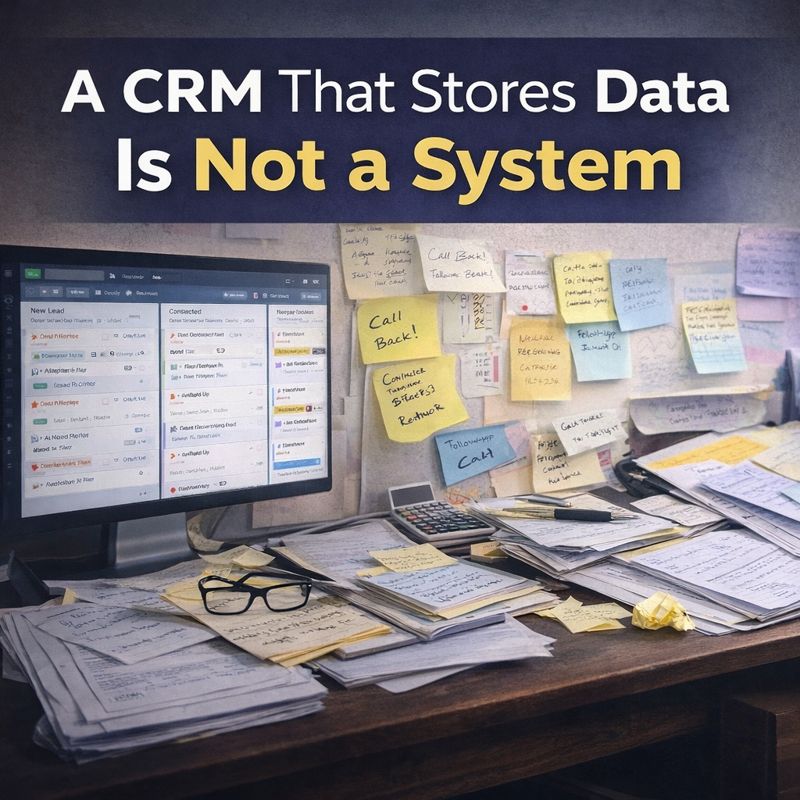
They fail because they were never designed to run the business, only to store information.
And those two things are not the same.
The False Promise Most CRMs Make
CRMs are marketed as if they magically solve chaos.
More organization.
More visibility.
More control.
But what they really give most agents is a digital version of what they already had:
- A list of leads
- Some notes
- A pipeline that looks nice
What they don’t give is clarity.
And without clarity, behavior doesn’t change.
A CRM that doesn’t change behavior will never change results.
The Moment Everything Breaks
Here’s where CRMs actually fail — not on day one, but weeks later.
A lead comes in.
You talk to them.
It’s a decent conversation.
They say something like:
“Let me think about it.”
“Follow up with me.”
“I’ll get back to you.”
You hang up feeling productive.
Then the CRM asks nothing of you.
No forced decision.
No required next step.
No deadline.
So the lead just… sits there.
And slowly, quietly, momentum dies.
Not because you forgot on purpose —
but because the system never demanded action.
Why Discipline Isn’t the Answer
This is where agents blame themselves.
“I need to be more organized.”
“I need to be more disciplined.”
“I need to check my CRM more often.”
That thinking is backwards.
Good systems don’t rely on discipline.
They replace it.
Insurance agents don’t lack motivation.
They’re overloaded with decisions.
And every open-ended lead adds another mental tab left open.
Eventually, something gives.
The Real Definition of a System
A system is not software.
A system is something that:
- Removes ambiguity
- Reduces decision-making
- Forces movement
If your CRM allows indecision, delay, or ambiguity, it’s not a system — it’s a database.
And databases don’t close policies.
The Three Rules That Decide Whether a CRM Works or Fails
Every effective CRM — regardless of brand — enforces the same three rules.
If even one is missing, the entire system weakens.
Rule 1: Every Lead Must Have a Next Action
Most CRMs are full of labels that feel useful but do nothing.
“Follow-up.”
“Nurture.”
“Contacted.”
Those aren’t actions.
They’re categories.
An action is specific and behavioral.
Examples:
- Call the lead
- Send a text
- Schedule an appointment
- Review underwriting
- Send application
If you open a lead and can’t answer exactly what happens next, the system has already failed.
Clarity creates momentum.
Ambiguity creates delay.
Rule 2: Every Action Must Have a Deadline
An action without a deadline is optional.
And optional actions get postponed until they disappear.
“I’ll call them back.”
“I’ll check in later.”
“I’ll follow up next week.”
Those statements feel responsible — but they’re vague.
Deadlines force prioritization.
They answer the question:
“When must this happen?”
Without deadlines:
- Every lead feels equally urgent
- Nothing rises to the top
- Follow-up becomes emotional instead of systematic
Deadlines turn good intentions into execution.
Rule 3: Every Deadline Must Trigger Automation
This is where most CRMs completely fall apart.
If a deadline passes and nothing happens, the CRM is just documenting failure.
Automation exists for one reason:
to intervene when humans get busy.
That doesn’t mean replacing the agent.
It means supporting reality.
Automation should:
- Remind
- Escalate
- Follow up
- Reassign
- Notify
When deadlines trigger automation, consistency appears without effort.
And consistency beats talent over time.
Why Features Don’t Save Broken Systems
Most CRM demos focus on visuals.
Dashboards.
Pipelines.
Reports.
Those things look impressive — but they don’t change behavior.
Behavior changes when:
- Actions are mandatory
- Deadlines are visible
- Consequences are automatic
That’s design.
A simple CRM with strong rules will outperform a powerful CRM with weak enforcement every time.
The Quiet Cost of CRM Failure
CRM failure doesn’t show up as disaster.
It shows up as:
- “They never got back to me”
- “That lead went cold”
- “I thought I followed up”
Multiply that by months.
That’s not a lead problem.
That’s a systems problem.
A Quick Self-Audit You Can Do Today
Pull up 10 random leads in your CRM.
For each one, ask:
- What is the next action?
- When must it happen?
- What happens if it doesn’t?
If you can’t answer all three instantly for most leads, your CRM isn’t enforcing behavior — it’s observing chaos.
That’s fixable.
The Shift That Changes Everything
High-performing agents don’t work harder.
They remove decisions.
They don’t ask:
“What should I do next?”
Their system already decided.
That’s when CRMs stop feeling like chores and start feeling like leverage.
Not because the software changed —
but because the rules did.
Final Thought
CRMs don’t fail because agents are lazy or undisciplined.
They fail because most CRMs were never designed to enforce action.
When your CRM demands:
- A next action
- A deadline
- Automatic consequences
It stops being something you have to remember.
And starts being something you can trust.
That’s when consistency shows up.
That’s when stress drops.
That’s when income stabilizes.
Not because you worked harder —
but because the system finally did.

0 Comments